
Joyful movement
The white space in wellbeing
Nike scored an own goal at the Boston Marathon this year. Their storefront ad, 'Runners welcome. Walkers tolerated', directly contradicted the brand's stated mission (still one of the best around) and drew a swift, well-deserved backlash on social media.
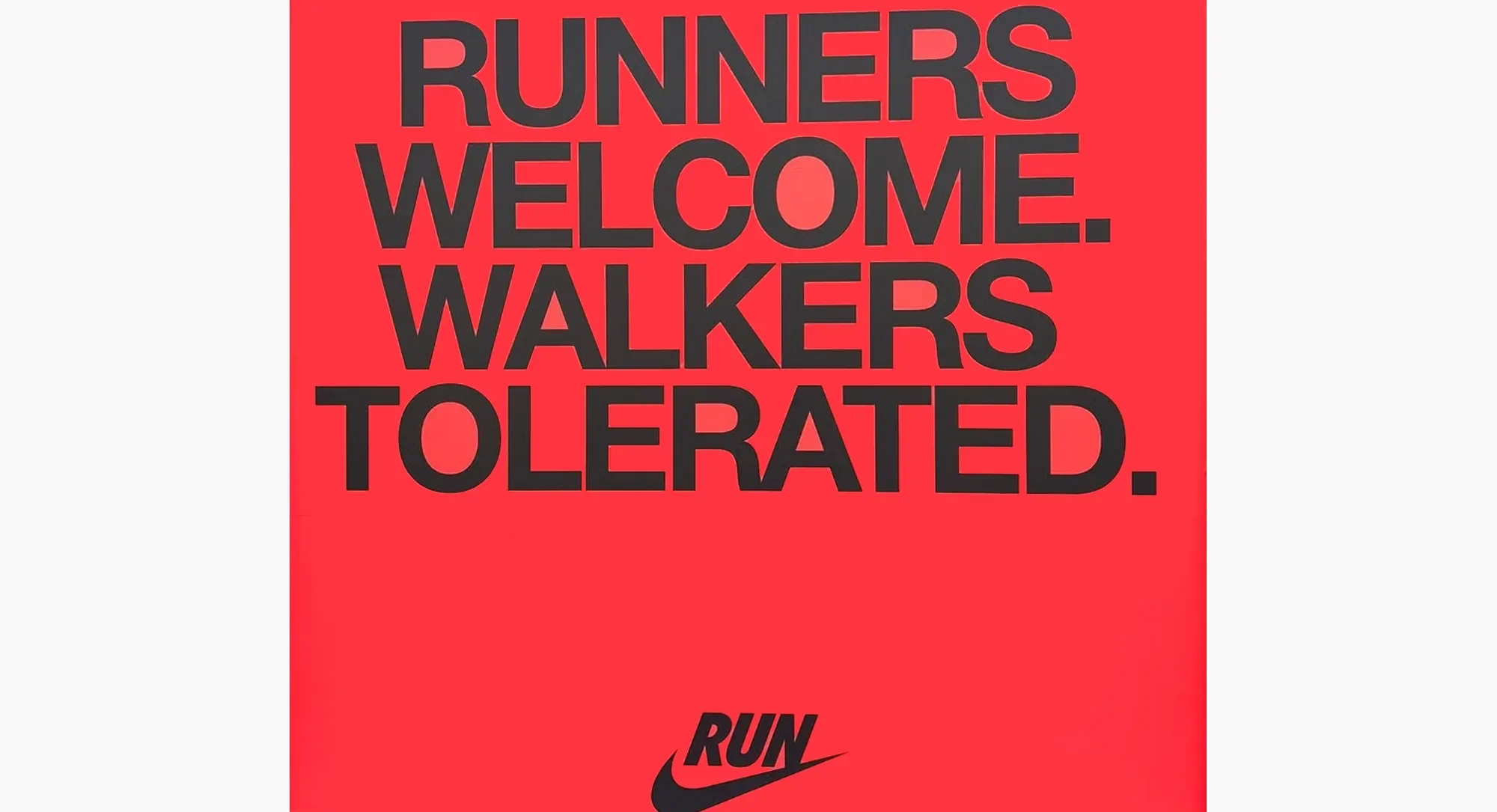
Image credit: WWD
The hasty reprint that followed, 'Boston will always remind you, movement is what matters', was safe enough to avoid further controversy but too anodyne to mean much.
Nike’s total drift away from itself, its consumer and its value as a brand is the subject for another post. What this debacle raised for me was a different question.
When did movement become all about exercise?
In developed markets, at least, the concept of movement has been almost entirely colonised by the fitness and wellness industry. Brands have explored different dimensions of what exercise can mean - performance and achievement at one end, mental escape and empowerment at the other, with duty and punishment somewhere in the middle - but the underlying logic has stayed remarkably consistent.
Movement is a task with a desired outcome. You go for a run, do a class, track your metrics.

Photo by John Arano on Unsplash
There's another version of movement that this framing leaves almost entirely unaddressed, and children show it to us every day.
For kids, movement isn't a task to be completed or a target to be hit. It's joyful, spontaneous and completely unstructured, shaped by curiosity and pleasure rather than outcome.

Photo by Jochen van Wylick on Unsplash
Something similar is beginning to emerge in adult spaces too - with group walks, ecstatic dance, play-based training and solo 'cosy' evening workouts. In all of these, people aren't really exercising in the traditional sense; they're simply moving their bodies because it feels good to do so.
That version of movement has no real owner yet, which is a striking gap given how large and lucrative the wellness category has become.
Conclusions
Nike's Boston ad didn't fail simply due to poor wordsmithing. It failed because it doubled down on hierarchy and performance at at time when broader culture is beginning to drift in the opposite direction.
The white space that opens up as a result isn't about finding a better tagline or a more inclusive campaign. It points to a fundamentally different relationship with the human body - one centred less on what the body can achieve and more on how movement actually feels.
Whoever works out how to own that territory, with genuine conviction rather than retrofitted messaging, will have an interesting brand on their hands.
